
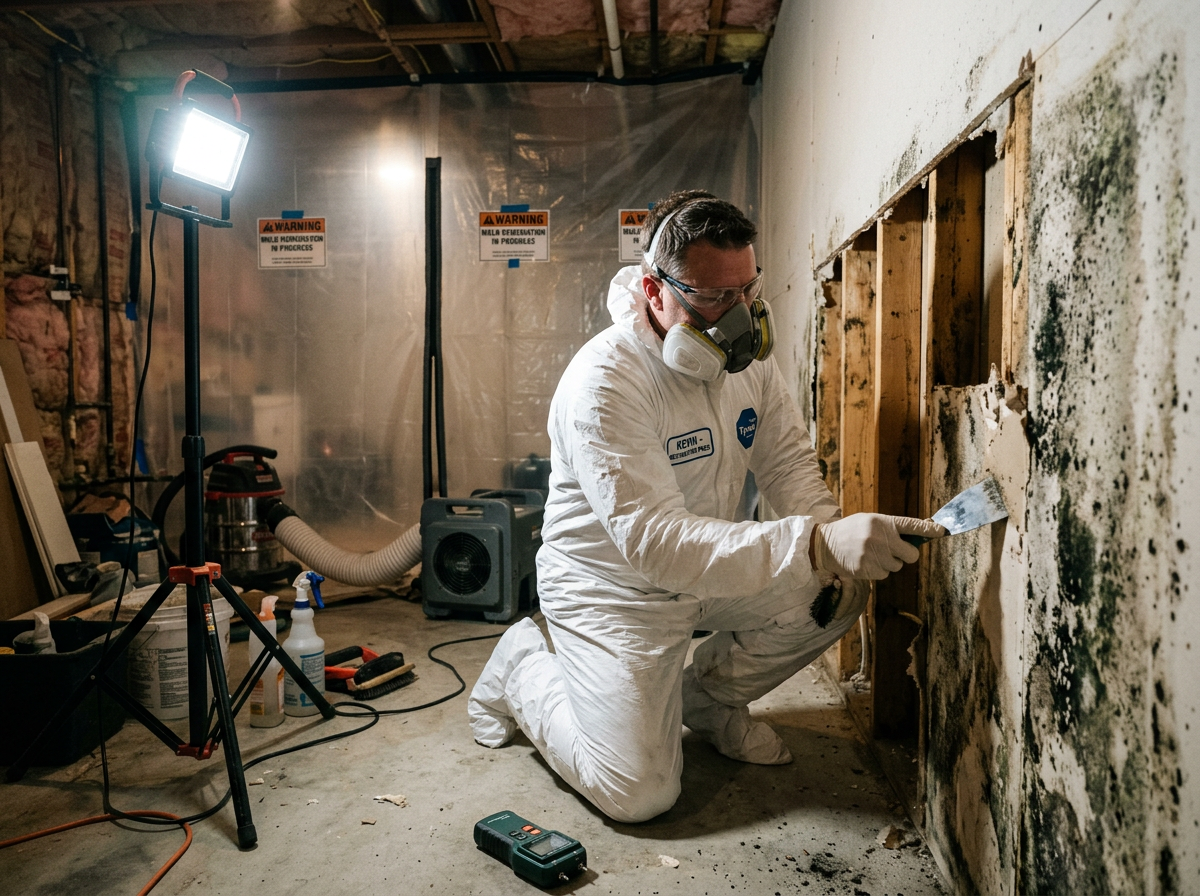
Suppression water left standing after winter fires in Payson and higher elevations often freezes inside wall cavities and attics before crews can extract it. When temperatures rise, the thaw feeds hidden colonies that spread through cellulose insulation and behind baseboards without visible surface signs. Dry winter air and tight modern envelopes keep the moisture trapped longer than in milder valleys, turning small leaks into widespread growth that standard fans never reach.
Technicians start by mapping moisture with meters and infrared before any demolition, because cutting into frozen cavities releases water that can re-soak already dried areas. Negative-air machines and physical barriers isolate the work zone so spores do not travel through HVAC returns into rooms the fire never touched. Once the source is opened, affected material is removed to the studs, surfaces are treated, and cavities are dried to documented dry standards rather than visual inspection alone.
Mold Remediation Near You — Choose Your City
Every city below has its own local Mold Remediation page with coverage details.
Washington County
Box Elder County
Utah County
Tooele County
Summit County
Cache County
Washington
Iron County
Wasatch County
Davis County
Box Elder
Summit
Weber County
Salt Lake County
Juab County
Morgan County
Cache
Jobs fail when homeowners attempt bleach cleaning on porous surfaces or when drying is stopped too soon because exterior temperatures feel cold. In Payson’s older neighborhoods, balloon-framed walls allow water to travel vertically for several stories before mold appears, requiring inspection of multiple floors even when damage seems localized to one room.
Technician insight
In Payson, the thing that catches most people out with Mold Remediation is how suppression water from winter fires above 4,500 feet freezes inside wall cavities and stays invisible until spring thaw, letting mold grow for weeks before any musty smell reaches the living area.
Frozen Suppression Water in Payson Split-Level
A kitchen fire in a Payson split-level led to heavy suppression water that froze in the lower wall cavities. Weeks later, a musty odor appeared on the main floor. We mapped moisture through the finished surfaces, opened the cavities, removed saturated insulation, and dried the framing before any visible mold reached the drywall.
Mold Remediation Services We Offer
✓Post-Fire Mould Containment
Physical barriers and negative-air setups isolate mold-affected zones created by standing suppression water so spores stay out of living spaces and HVAC systems.
✓Moisture Source Correction
Extraction and drying of water trapped in cavities above 4,500 feet where winter freezing delayed evaporation and allowed mold to establish.
✓Wall Cavity Mold Remediation
Targeted removal of insulation and sheathing behind finished surfaces where meltwater from frozen suppression water has fed hidden colonies.
✓Attic Mold Removal After Suppression
Clearing mold growth in roof spaces common after ember intrusion fires when water from suppression lines pools on ceiling joists and insulation.
✓Post-Remediation Verification
Moisture readings and visual inspection confirming all affected material has been removed and remaining surfaces meet dry standards before reconstruction begins.
How it works
- 1
Moisture Mapping
Technicians use meters and thermal imaging to locate hidden water from suppression lines that froze and later thawed inside walls and attics.
- 2
Containment Setup
Sealed barriers and negative air machines are installed to prevent cross-contamination into unaffected rooms and ductwork.
- 3
Material Removal and Cleaning
Wet or moldy drywall, insulation, and trim are cut out; remaining surfaces receive appropriate antimicrobial treatment.
- 4
Drying and Verification
Industrial dehumidifiers and air movers bring cavities to documented dry levels, followed by final moisture checks.
Pricing
Scope is determined by hidden moisture extent, number of affected cavities, and square footage requiring removal after inspection. Call for a site assessment.